Sleep by day, hunt the sky by night — the pursuit of the northern lights is equal parts meteorology, patience, and the willingness to stand in the cold dark for something miraculous.
February 8, 2025
The forecast said KP4. The cloud cover said nothing good. We drove anyway.
That's the central lesson of aurora hunting: you can study the geomagnetic indices, check the Space Weather Prediction Center's 27-day forecast, download three different aurora apps, and still end up standing in a frozen parking lot at 2 a.m. watching a wall of grey. Or you can do all the same preparation and turn a corner on the Snæfellsnes Peninsula to find the entire sky on fire.
Aurora is a game of thresholds — atmospheric, meteorological, personal. You have to be willing to lose before you can win.
The Setup: East Iceland in February
We based ourselves near Höfn, a small fishing town on Iceland's southeastern coast, chosen specifically because it sits east of the cloud systems that tend to mass over Reykjavik in winter. The accommodation was a converted farmhouse, ancient and warm, staffed by a woman named Sigrid who had opinions about aurora photography that she delivered in impeccable English with the patient authority of someone who had watched a thousand tourists make the same mistakes.
"Stop using the flash," she said, reviewing a guest's photos over breakfast on day two. "And stop looking at your phone."
What the Apps Don't Tell You
Good aurora hunting is about understanding the sky, not just checking a number. A KP3 in rural Iceland with zero light pollution and clear skies will outperform a KP7 seen through thin cloud cover from a city.
The key variables:
- KP index — measures geomagnetic storm intensity (2+ is possible; 4+ is reliably visible if skies are clear)
- Cloud cover — the real enemy. Even thin cirrus will wash out the aurora entirely
- Light pollution — drive at least 30 minutes from any settlement
- Lunar cycle — a full moon competes; new moon is ideal
The aurora apps give you the first variable. The other three require reading actual weather forecasts and knowing your location. The Icelandic Met Office (vedur.is) is far more reliable than any phone app for local cloud forecasts.
Three Nights, Three Outcomes
Night one: KP2, total cloud cover. We drove 90 minutes toward clearer skies and found none. Returned at 4 a.m., slept, ate enormous breakfasts.
Night two: KP3, partial clearing northeast. We found a frozen lake at midnight, a half-broken sky, and the faintest green shimmer on the horizon. Not a poster. Real.
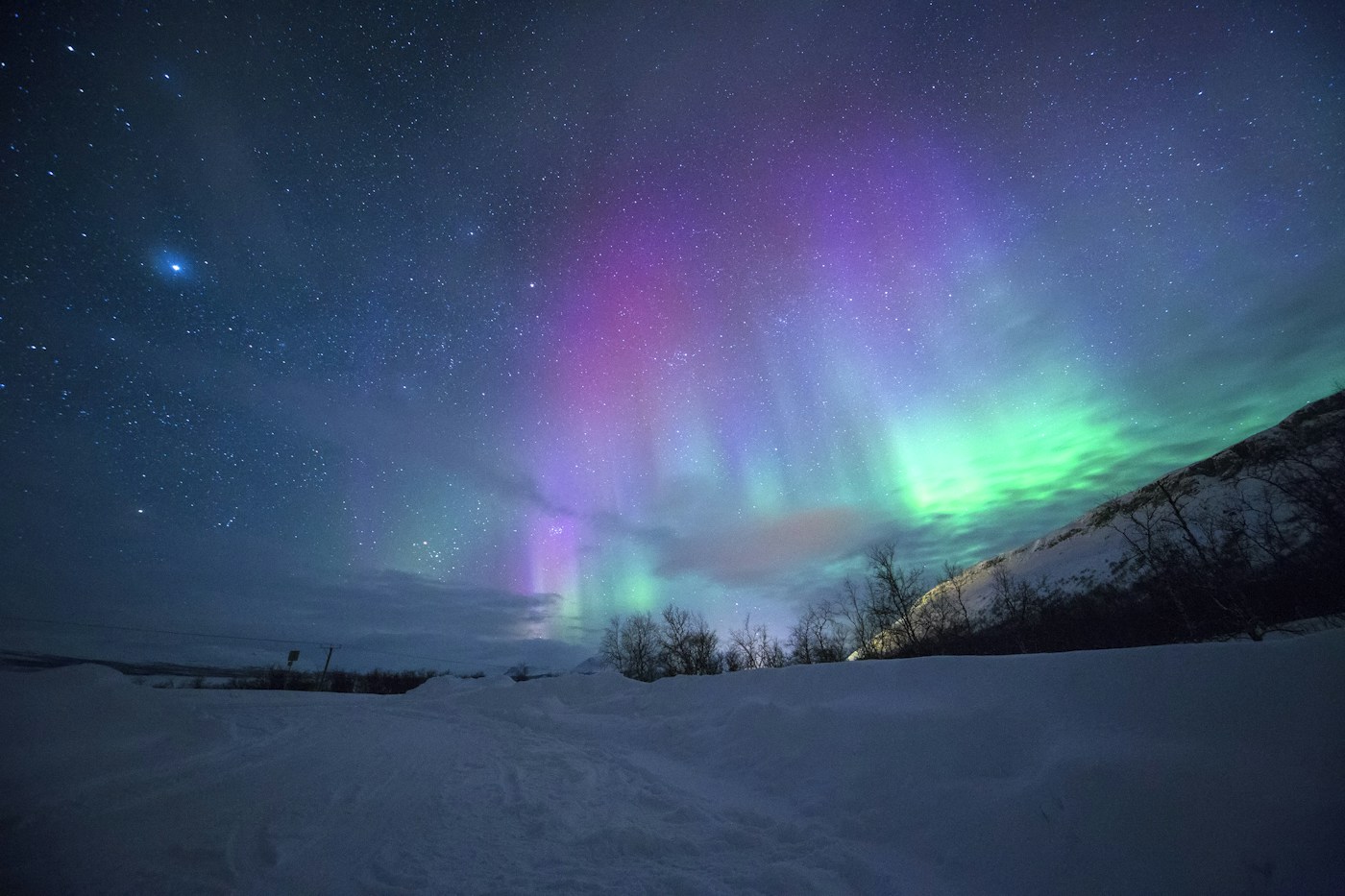
Night three: KP5, sudden clearing after a day of snow. We stepped outside at 11 p.m. because the sky had changed texture — that's the thing no one tells you. You can sometimes feel it coming. The aurora ran from the eastern horizon to directly overhead, shifting from green to violet to white in a movement that felt more architectural than meteorological. Like watching something being built in fast forward.
Sigrid found us at midnight with a thermos of hot chocolate. "I thought you might be outside," she said.
Practical Notes
Go between October and March. The equinox periods (September–October and February–March) offer peak aurora activity combined with manageable temperatures.
Rent a car. Guided tours exist but you lose the ability to chase gaps in the cloud cover, which is often the difference between seeing something and seeing nothing.
Dress for —15°C. Even if it's only —5°C. You will be standing still for hours.
Bring a tripod. Phone aurora photos are mostly bad. A mirrorless camera at ISO 1600, f/2.8, 10-second exposure will capture what you actually see.
Be patient with patience. The best aurora I've seen came on the night I'd decided to give up and go back to bed.